"Monstrous absurdity! You seek at a distance that which lies close to your hands, as if the Everyday Objects above, beneath, and around, were unworthy of the science you profess."
The swallowtail cats are turning out to be just as pretty as the monarchs were.
Later instars look completely different from early instars (like the one at the top).
The process of molting appears to be much the same as the monarchs'.
The osmeterium is the really interesting (and fairly unique) feature of swallowtail cats. When disturbed (I stroked this one with a leaf), the cat rears back its head and pushes out the osmeterium - a weird and horrible-smelling orange organ shaped like a Y - and tries to wipe it on the offender. Apparently they use this to try to defend themselves against predators. For a bit more info see this site, and for a lot more info, read this article.
After first shedding their head capsule, the cats' heads are very pale. They vehemently dislike being disturbed before their exoskeleton has the chance to harden again.
Watching the cats pupate was one of the most startling and amazing things I've ever experienced! It is sinking in how utterly "other" these creatures are. Most of their body will essentially dissolve, and their imaginal disks will kick in start growing the butterfly that will emerge in a few weeks. They are truly starting life over from practically the embryonic stage!Check out this great article on butterfly pupation
First, the cats stopped eating and began crawling around their cage. When they found a nice, sheltered spot they attached themselves to the surface with silk and gently lowered themselves into a hanging position.
Assuming the "J position"
Eventually I could detect the sheen of pale green under the cat's skin.
Throughout the J position, the cat convulsed and clenched its body. I can only assume that it was loosening its skin in preparation for the final molt. Shortly before the big moment, the cats front tentacles withered and went limp.
Then, the incredible happened:
Whoo! This stuff makes me giddy :)
The cat suddenly straightened out, and the skin behind its head began to split.
Stunning - simply stunning!! This moment alone has made all the hard work over the past few weeks well worth it. I am peering into the lives of such amazing, alien little creatures. They're common, everyday little things that most people over the age of about twelve completely ignore. I feel really blessed to be regaining, in a way, the passion for this stuff that I had when I was younger but very nearly lost as a teenager.
Looks like I wont need to wait till next year to try raising swallowtails! I found several eggs on our little parsley plant while I was harvesting milkweed for the cats. I brought as many in as I could find, since I noticed some wasps hanging about. The idea of letting them get parasitzed in unpleasant, since it wouldn't be that much work to just bring them in (she lied, trying desperately to convince herself). I believe that they are Papilio polyxenes.
The eggs start off a honey color. Notice how different the shape of these eggs are from the Monarch eggs! These are almost perfectly spherical.
As was the case with the monarch cats, they turn black right before hatching.
Size comparison
Like a beautiful black pearl
Eating the shell
These cats look so different from the monarchs! Their setae and spines are much larger and more noticeable. I think I read somewhere that the early instar larvae resemble bird droppings as a protective measure.
Size comparison right after hatching.
I ran into several problems with the Swallowtail cats right away. First off, they are as tiny as the monarch cats were, and just as prone to wandering or getting crushed. I lost a few trying to transfer them to fresh leaves. Later on I realized with alarm that there wasn't enough parsley in the garden for them at the rate they were consuming it. Unfortunately when I bought some from the grocery store, it must have had pesticides on it since even after a thorough cleaning the cats who ate it quickly died. I managed to find an organic source of curly parsley and that worked fairly well.
I'm gaining a better appreciation of the entire "community" of creatuures living in the milkweed patches. Today I spotted some lacewing eggs among the ever-present aphid herds on the milkweed leaves. If I wasn't already busy enough looking after the cats I'd try raising a few of them. Maybe next year.
The eggs are really interesting and beautiful. They hang from long threads to provide the newly-hatched larvae some measure of protection from each other (my source). Lacewing are voracious eaters - those aphids will have no chance! They're often sold as beneficial insects for pest management. More info on lacewings . I'm pretty sure that this insect
that I found at Cox earlier was an adult lacewing.
Sooo clearly a bit of time has passed in between posts here. School tends to require putting everything else on pause, unfortunately. Over the break I'll try to upload of bunch of pics to finish up my little narrative. Without further ado:
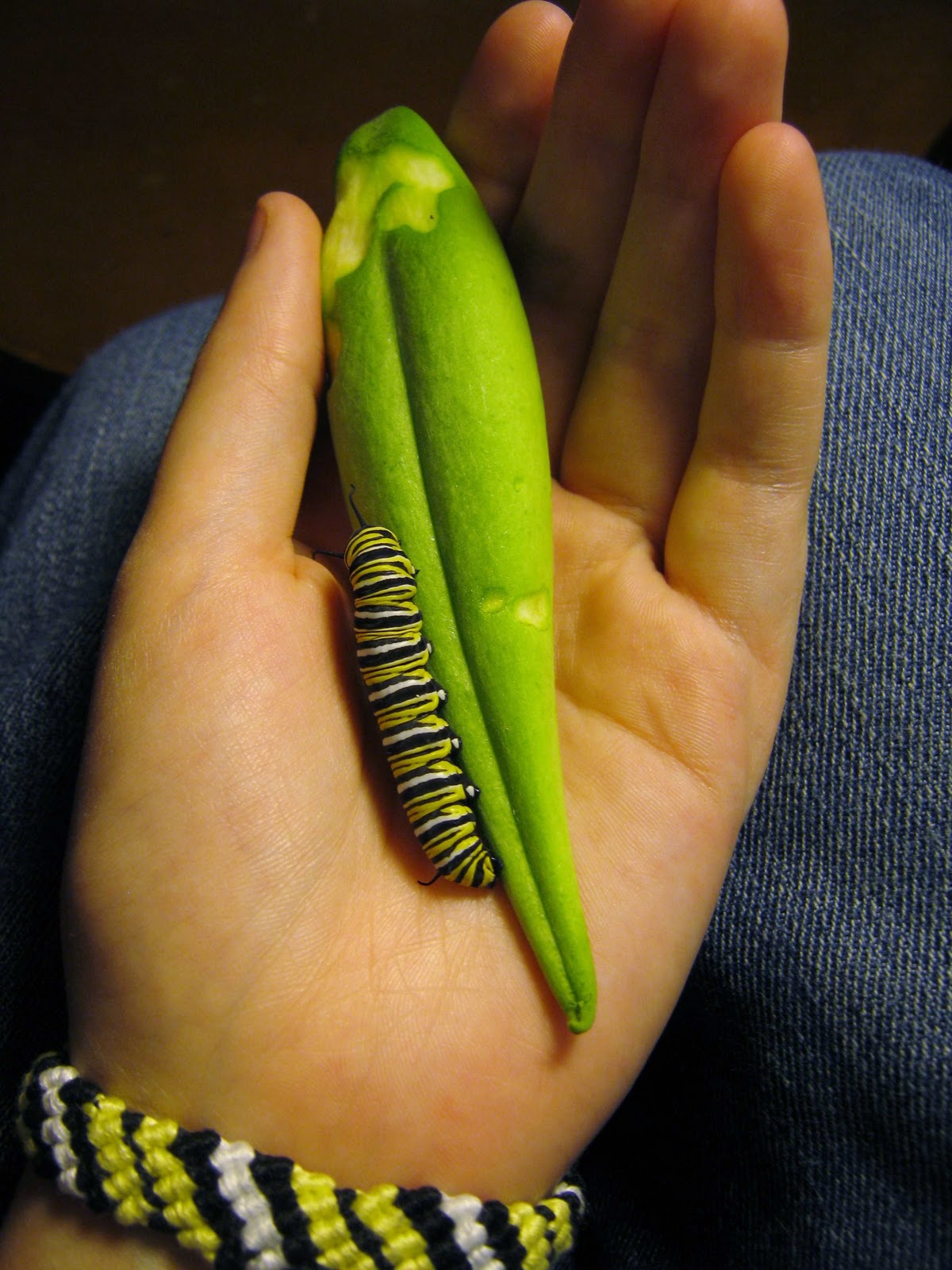
Fifth instar cats are nothing short of magnificent! Their colors are far more vivid the pics illustrate. It's hard to reconcile the image of these big, plump caterpillars with the tiny creatures who emerged from tiny eggs such a short time ago. After reading a recommendation on the Internet someplace, I tried feeding the three cats milkweed pods in addition to the leaves. It was a huge success - they munched away quite happily.
Shedding the head capsule...
...and pulling free of the skin. In molting, the cats attach their rear prolegs to a secure surface. After the head capsule has been removed, the slowly walk out of the old skin.